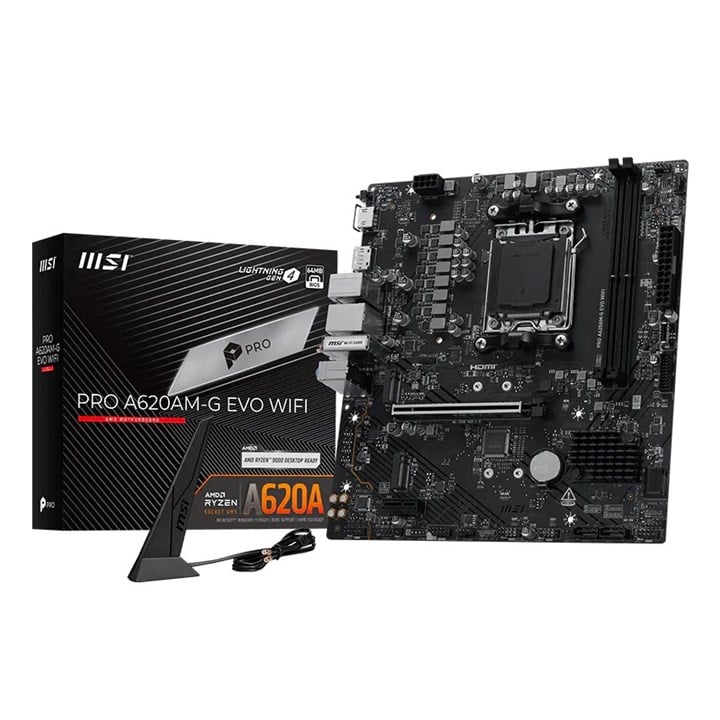
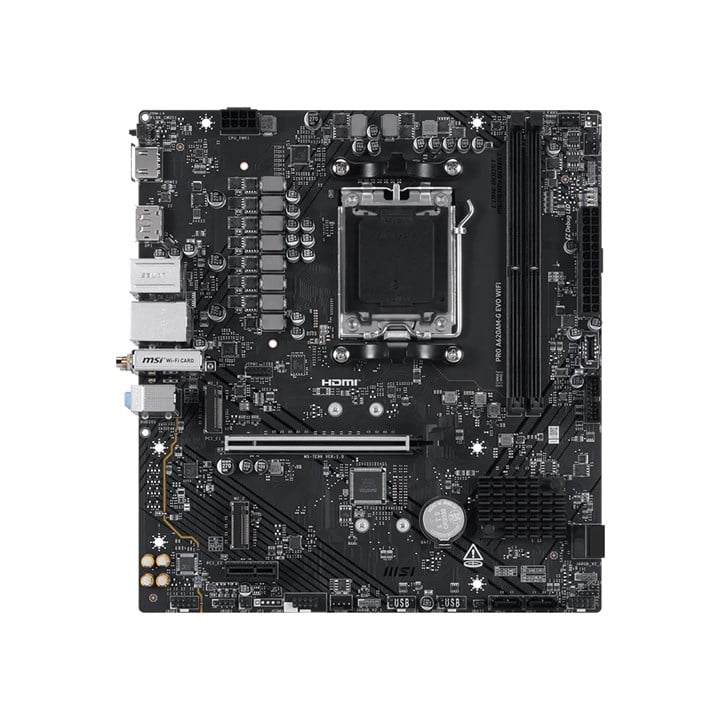
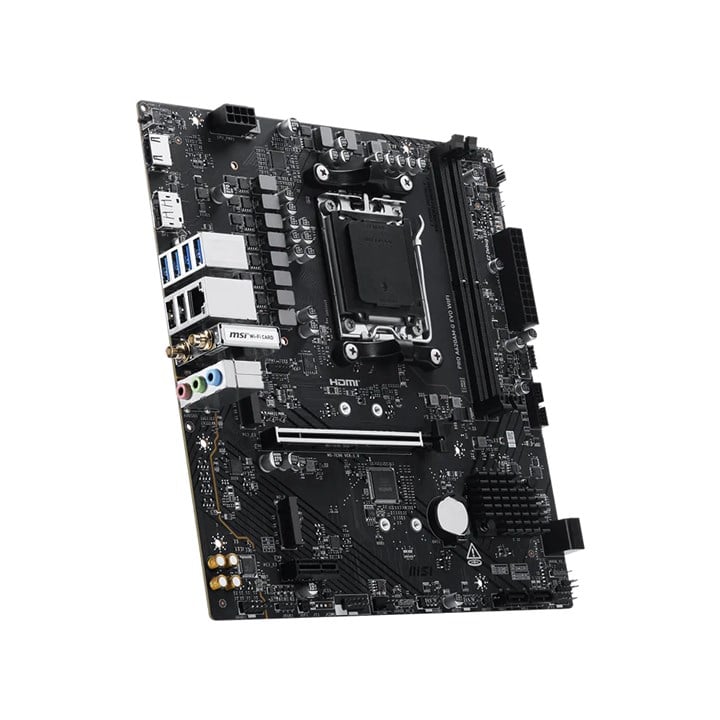
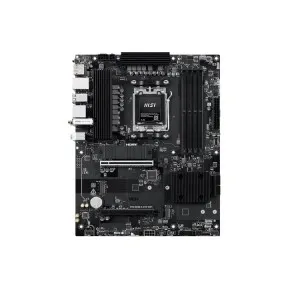
MSI Pro A620AM-G EVO WIFI mATX Socket AM5 Motherboard

  • Part Number: PRO A620AM-G EVO WIFI
  • Manufacturer: MSI
  • Quickfind Code: 136573

  • Stock: In Stock

£83.59 ex. vat
£100.31 inc. vat


Product Features:
  • Condition: New
  • Socket Type AM5
  • Chipset A620
  • Form Factor mATX
  • Memory Type DDR5
  • CPU Type AMD
+ Read More Information

Share:

Product Description

PRO A620AM-G EVO WIFI
PRO A620AM-G EVO WIFI is designed with tons of flexible tools with DDR5 memory and Wi-Fi 6E.

BUSINESS ELEGANCE
The PRO Series is tailored to professionals from all walks of life. The lineup features impressive performance and high quality, while aiming to provide users incredible experience. Users who care about productivity and efficiency can definitely count on the MSI PRO Series to assist you with multitasking and increasing efficiency.

Chipset Heatsink
The chipset heatsink is designed to reduce dust and noise and also capable of maintaining high efficiency of PCH.

CORE BOOST
Core Boost technology combines MSI's premium layout and optimized power design which allows for faster and undistorted current delivery to the CPU at pin-point precision. Not only supporting multi-core CPU, also creating the perfect conditions for your CPU overclocking.

LIGHTNING GEN 4 PCI-E
MSI lightning Gen 4 PCI-E represents the bandwidth of a x16 interface to 64GB/s that has doubled compared to its previous generation.

REINFORCED,
HEAVY SOLDERED CONNECTIONS

MSI PCI Express Steel Armor slots are secured to the motherboard with extra solder points and support the weight of heavy graphics cards. When every advantage in games counts, Steel Armor shields the point of contact from electromagnetic interference.

LATEST DDR5 MEMORY WITH SMT SLOT
A huge step of DDR performance enhancement with the latest DDR5 memory. Combines with dedicated SMT welding process and MSI Memory Boost technology, MSI PRO Series motherboards are ready to deliver the world class memory performance.

The advanced SMT(Surface Mount Technology) welding process reduces the defect rate of slot solder joints, electromagnetism, and interference. Combining with exclusive Memory Boost technology allows MSI motherboards to deliver the clean and pure high-frequency DDR5 signal.

MSI brand new MSI Center unifies a suite of MSI software utilities into a single centralized application. Take control of advanced motherboards features and unleash endless possibilities.

Exclusive UI of AIDA64 Extreme
MSI motherboards provide 60 days free trial of AIDA64 Extreme - MSI edition. AIDA64 Extreme is an almighty application for system information, diagnostics and benchmarks. With the application, you can monitor the detailed hardware and software information on PC and save it to file in multiple formats such as CSV and HTML.

MSI’s newly designed CLICK BIOS X offers an aesthetically pleasing and user-friendly experience. The new design ensures that users of all experience levels can quickly access and adjust system configurations with ease.

Resizable BAR (Re-Size BAR) is an advanced PCI Express feature that enables the CPU to access the entire GPU frame buffer at once and improve performance.

Technical Specification

MSI Pro A620AM-G EVO WIFI mATX Socket AM5 Motherboard

Processor
Processor manufacturer
The manufacturer that produced the processor.
AMD
Processor socket
Mechanical component(s) that provides mechanical and electrical connections between a microprocessor and a printed circuit board (PCB). This allows the processor to be replaced without soldering.
Socket AM5
Compatible processor series
A processor which is compatible with this device, belongs to a 'series' which is part of 'family' e.g Celeron D, Celeron G, Celeron M, or, in some cases, is the same as 'family'.
AMD Ryzen 7000 Series, AMD Ryzen 8000 Series, AMD Ryzen 9000 Series
Supported processor sockets
The sockets (plugs) for processors that are supported (can be used) by the device.
Socket AM5
Memory
Supported memory types
Types of memory which can be used with the product.
DDR5-SDRAM
Number of memory slots
The total number of available sockets for installing memory modules.
2
Memory slots type
A memory slot, also known as a memory socket or RAM slot, is what allows computer memory (RAM) to be inserted into the computer. Depending on the motherboard, there will usually be 2 to 4 memory slots (sometimes more on high-end motherboards). The most common types of RAM are SDRAM and DDR for desktop computers and SODIMM for laptop computers, each having various types and speeds.
DIMM
Memory channels
The number of communication paths between the memory controller and the RAM, which affects data transfer bandwidth (e.g., Dual-channel).
Dual-channel
ECC ?ompatibility
Specifies whether the product supports Error Correction Code (ECC) memory, which detects and fixes data corruption (e.g., ECC, non-ECC).
Non-ECC
Supported memory clock speeds
Memory clock speed is the time it takes for a computer to complete basic operations. It refers to the computer's processing speed and is measured in hertz. It is however not such a reliable measure of a computer's speed as it doesn't take into account other factors like RAM and cache size.
7200, 5600, 4800 MHz
Supported memory clock speed (max)
The maximum frequency at which the system memory can operate, measured in MHz.
7200 MHz
Maximum internal memory
The maximum internal memory which is available in the product.
128 GB
Unbuffered memory
Indicates whether the device supports the use of unbuffered memory modules.
 
Storage controllers
Supported storage drive interfaces
The physical and logical connection standards supported for connecting storage drives to the system (e.g., M.2 or SATA).
M.2, SATA III
Number of HDDs supported
The total number of hard drives that can be used in/with this product.
4
Number of storage drives supported
How many storage drives can be fit into the product at once.
6
RAID support
The device uses RAID, which is a storage technology that combines multiple disk drive components into a logical unit for the purposes of data redundancy and performance improvement. Data is distributed across the drives in one of several ways, referred to as RAID levels, depending on the specific level of redundancy and performance required.
 
RAID levels
RAID is a storage technology that combines multiple disk drive components into a logical unit for the purposes of data redundancy and performance improvement. Data is distributed across the drives in one of several ways, referred to as RAID levels, depending on the specific level of redundancy and performance required.
0, 1, 10
Graphics
Parallel processing technology support
Parallel processing technology is the simultaneous use of more than one CPU or processor core to execute a program or multiple computational threads. Ideally, parallel processing makes programs run faster because there are more engines (CPUs or Cores) running it. In practice, it is often difficult to divide a program in such a way that separate CPUs or cores can execute different portions without interfering with each other. Most computers have just one CPU, but some models have several, and multi-core processor chips are becoming the norm. There are even computers with thousands of CPUs.
Not supported
On-board graphics card
Graphics hardware which is built into the motherboard or CPU, as opposed to a separate graphics adapter (video card). On-board graphics uses CPU and RAM for graphics processing.
 
Internal I/O
USB 2.0 connectors
The end of a cable with a USB 2.0 connector. USB 2.0 was released in April 2000 (now called "Hi-Speed"), adding higher maximum signaling rate of 480 Mbit/s (effective throughput up to 35 MB/s or 280 Mbit/s), in addition to the "USB 1.x Full Speed" signaling rate of 12 Mbit/s. USB 2.0 connectors are usually colored black.
4
USB 3.2 Gen 1 (3.1 Gen 1) connectors
This is a connector (normally attached to a cable) for USB 3.0. USB 3.0 is the second major revision of the Universal Serial Bus (USB) standard for computer connectivity. First introduced in 2008, USB 3.0 adds a new transfer mode called "SuperSpeed," (distinguishable from USB 2.0 by either the blue colour of the port or the initials SS) capable of transferring data at up to 5Gbit/s—more than ten times as fast as the 480 Mbit/s top speed of USB 2.0.
2
USB 3.2 Gen 2 (3.1 Gen 2) connectors
The total number of internal or external ports supporting the USB 3.2 Gen 2 (3.1 Gen 2) standard for high-speed data transfer.
1
Number of SATA III connectors
Serial ATA (Advanced Technology Attachment) (SATA) is a computer bus interface that connects host bus adapters to mass storage devices such as hard disk drives and optical drives. SATA III (revision 3.x) interface, formally known as SATA 6Gb/s, is a third generation SATA interface running at 6.0Gb/s. The bandwidth throughput, which is supported by the interface, is up to 600MB/s. This interface is backwards compatible with SATA 3 Gb/s interface.
4
ATX Power connector (24-pin)
Indicates whether the product features a 24-pin ATX power connector for main power supply connectivity.
 
Rear panel I/O ports
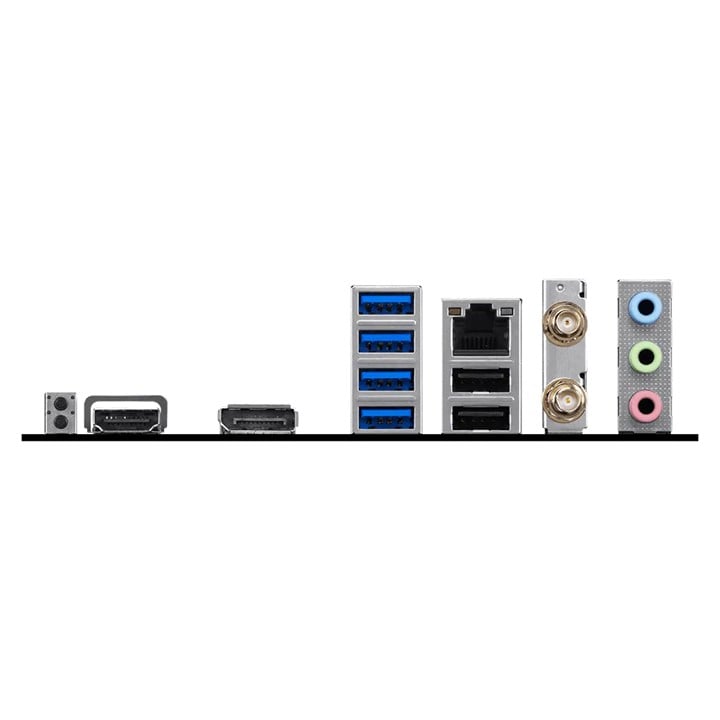
USB 2.0 ports quantity
Number of USB 2.0 ports (connecting interfaces) in the device. USB 2.0 was released in April 2000 (now called "Hi-Speed"), adding higher maximum signaling rate of 480 Mbit/s (effective throughput up to 35 MB/s or 280 Mbit/s), USB 2.0 ports are usually black.
2
USB 3.2 Gen 1 (3.1 Gen 1) Type-A ports quantity
The total number of available USB 3.2 Gen 1 (formerly 3.1 Gen 1) Type-A connection ports on the device.
4
Ethernet LAN (RJ-45) ports
Number of Ethernet LAN (RJ-45) ports (connecting interfaces) in the device. Ethernet LAN (RJ-45) ports allow a computer to connect to the ethernet.
1
VGA (D-Sub) ports quantity
Number of VGA (D-Sub) ports (connecting interfaces) in the device. The VGA (D-Sub) connector is a 15 pin connector between a computer and a monitor. It was first introduced in 1987 by IBM.
1
HDMI ports quantity
The number of sockets (ports) for HDMI connections. HDMI (High-Definition Multimedia Interface) is a compact audio/video interface for transferring uncompressed video data and compressed/uncompressed digital audio data from a HDMI-compliant device ("the source device") to a compatible computer monitor, video projector, digital television, or digital audio device. HDMI is a digital replacement for existing analog video standards.
1
HDMI version
The specific release version of the High-Definition Multimedia Interface standard supported by the device (e.g. 1.3 or 2.0).
2.1
Rear panel I/O ports
DisplayPorts quantity
Number of DisplayPorts. A DisplayPort is a digital display interface developed by the Video Electronics Standards Association (VESA). The interface is primarily used to connect a video source to a display device such as a computer monitor, though it can also be used to carry audio, USB, and other forms of data.
1
DisplayPort version
The specific release version of the DisplayPort standard supported by the device (e.g., 1.2 or 1.4).
1.4
Network
Ethernet LAN
An Ethernet LAN (Local Area Network) interface is present, for a wired conection via a cable.
 
Ethernet interface type
The maximum data transfer rate supported by the network port, expressed in gigabits per second (e.g., 10 Gigabit Ethernet).
2.5 Gigabit Ethernet
Wi-Fi
Popular technology that allows an electronic device to exchange data or connect to the internet wirelessly using radio waves.
 
Top Wi-Fi standard
Connection of this device is done via Wi-Fi in a high standard.
Wi-Fi 6E (802.11ax)
Wi-Fi standards
The type of wireless local area network (LAN). It can be ad-hoc, where units in a network communicate peer-to-peer, or Infrastructure, where units communicate with each other via an access point A LAN interconnects computers in a small area e.g. home, school or office.
Wi-Fi 6E (802.11ax), 802.11a, 802.11b, 802.11g, Wi-Fi 4 (802.11n), Wi-Fi 5 (802.11ac)
Features
Motherboard chipset
The chipset connects the microprocessor to the rest of the motherboard.
AMD A620A
Audio output channels
An audio output channel is an electric circuit which acts as a path for a signal produced by a device. A device may have several audio output channels.
7.1 channels
Product colour
The colour e.g. red, blue, green, black, white.
Black
Component for
What this product is used as a part of (component for).
PC
Motherboard form factor
Design of the motherboard (ATX, BTX etc).
micro ATX
Motherboard chipset family
The category of motherboard chipset e.g. Intel, AMD.
AMD
Windows operating systems supported
Windows vesions wich can be used with the device.
Windows 10, Windows 11
Expansion slots
PCI Express x1 (Gen 3.x) slots
The number of available PCI Express x1 slots supporting generation 3.x specifications for expanding the device's functionality.
1
PCI Express x16 (Gen 4.x) slots
The number of available expansion slots supporting the PCI Express 4.0 standard with x16 lane connectivity.
1
Number of M.2 (M) slots
The total number of available M.2 M-key slots for installing high-speed storage devices or expansion cards.
2
1st M.2 largest key size
The maximum physical dimensions of the M.2 module supported by the first slot, typically expressed as width and length (e.g., 2280).
2280
1st M.2 highest PCI Express generation
The maximum supported PCI Express version for the first M.2 slot (e.g., 4.0).
4.0
2nd M.2 largest key size
The maximum physical dimensions supported for the second M.2 slot, typically expressed as width and length (e.g. 2280).
2280
2nd M.2 highest PCI Express generation
The maximum supported PCI Express version for the second M.2 slot (e.g., 4.0).
4.0
BIOS
BIOS type
The BIOS (Basic Input/Output System) initializes and tests system hardware components, and loads a bootloader or an operating system from a mass memory device. The BIOS additionally provides abstraction layer for the hardware, i.e. a consistent way for application programs and operating systems to interact with the keyboard, display, and other input/output devices. There are several types of BIOS, including the motherboard ROM BIOS, video BIOS, drive controller BIOS, network adapter BIOS, and SCSI adapter BIOS.
UEFI AMI
BIOS memory size
The total storage capacity of the basic input/output system chip, measured in Mbit.
512 Mbit
ACPI version
The version of the Advanced Configuration and Power Interface standard supported by the device to manage power consumption and hardware configuration (e.g., 2.0).
6.5
System Management BIOS (SMBIOS) version
The specific version of the System Management BIOS standard supported by the firmware (e.g. 2.7), which defines how hardware information is communicated to the operating system.
3.7
Weight & dimensions
Width
The measurement or extent of something from side to side.
226 mm
Depth
The distance from the front to the back of something.
243.8 mm

Fast Next Day Delivery

Over 20 years of Supply, Service & Support

We Source Hard to Find and Legacy Computer Parts

Free Technical Support