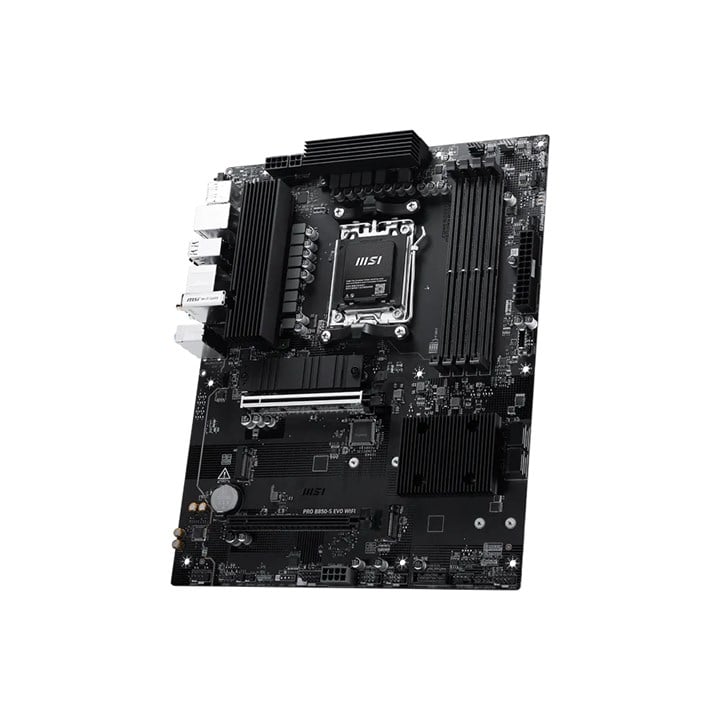
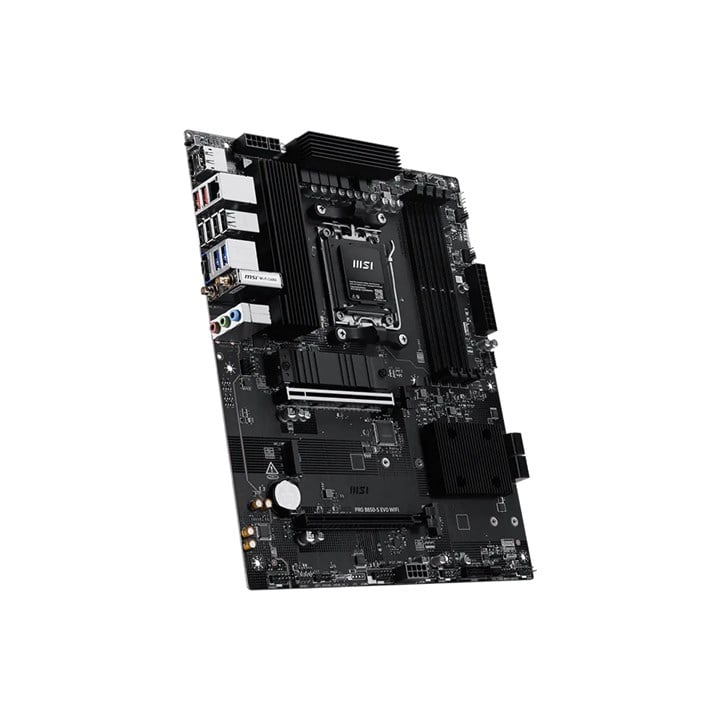
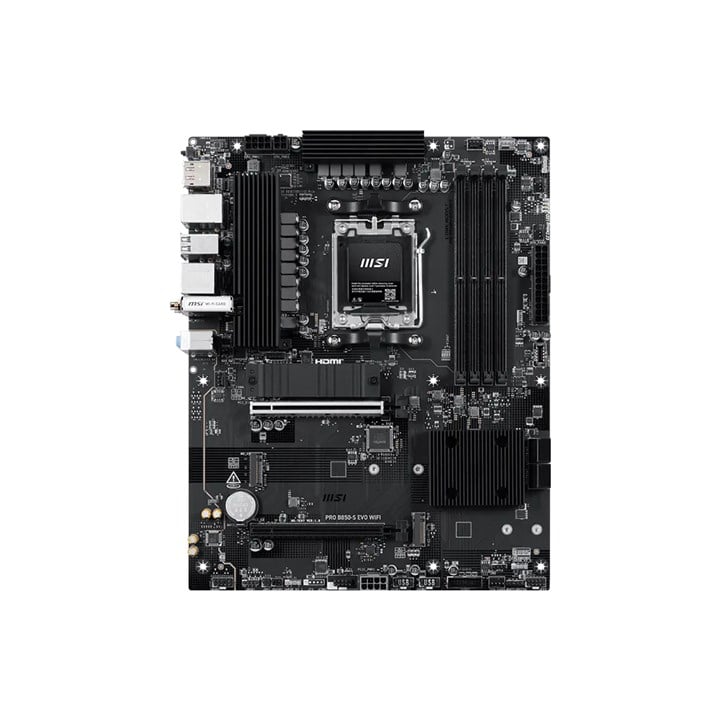
MSI PRO B850-S EVO WIFI ATX Socket AM5 Motherboard

  • Part Number: PRO B850-S EVO WIFI
  • Manufacturer: MSI
  • Quickfind Code: 136572

  • Stock: In Stock

£132.59 ex. vat
£159.11 inc. vat


Product Features:
  • Condition: New
  • Socket Type AM5
  • Chipset B850
  • Form Factor ATX
  • Memory Type DDR5
  • CPU Type AMD
+ Read More Information

Share:

Product Description

PRO B850-S EVO WIFI
PRO B850-S EVO WIFI offers a simple design with a harmonious black color scheme that perfectly matches black PC builds. It is engineered with many exclusive features of MSI, a Wi-Fi 7 with EZ Antenna, 5G LAN, PCIe 5.0 M.2 with M.2 Shield Frozr, EZ PCIe Clip II, and Supplemental PCIe Power, ready for the AMD Ryzen™ 9000 series processors

The PRO Series is tailored to professionals from all walks of life. The lineup features impressive performance and high quality, while aiming to provide users incredible experience. Users who care about productivity and efficiency can definitely count on the MSI PRO Series to assist you with multitasking and increasing efficiency.

MSI motherboards are designed with advanced hardware and technology, well-supporting the demanding computing usage of gaming and AI. Moreover, we also introduce AI to MSI Center and BIOS, making everything more effortless than before.

The new EZ PCIe Clip II, located on the first slot, features the rebounding force mechanism that allows for easy removal of the graphics card by pressing the tail-like lock with one finger. Due to this exquisite design, users can uninstall the graphics cards effortlessly, even in the cramped case spaces.

MSI motherboards circuitry ensure the case standoff keep out zones are pure and clean. Moreover, the protective paint is printed around each screw hole to prevent parts from being scratched or damaged to the motherboard.

MSI EZ Antenna makes the process effortless by simply attaching fasteners to the motherboard without rotation.

EZ DEBUG LED
Onboard LEDs will indicate the source of the problem so you know exactly where to look to get up and running again.

EZ Memory Detection LED
This LED lights up when it detects faulty memory in slots, eliminating guesswork from troubleshooting.

While overclocking can be overly complex for some, MSI Click BIOS X made it more accessible with multiple one-click overclock features for both processor and memory, allowing users to easily enhance system performance without delving into intricate settings.

A host of features inject artificial intelligence into key aspects of your computing experience to make smarter, real-time optimizations. The MSI Center offers a clean, minimal interface to customize and manage your PC settings. The AI Engine, for example, automatically adjusts settings based on the applications you're using, ensuring seamless performance.

Unleash and sustain the maximum performance with a flagship VRM design built with a total of 12+2+1 digital power phases. With 8+4 power connectors, PRO B850-S EVO WIFI is ready for the challenge of high-end processors.

MSI utilizes PCB Fabric Technology to enhance signal performance, resulting in higher bandwidth and faster data transfer while minimizing signal loss. The PCB Fabric Technology also offers better impedance control and improved thermal stability, allowing the boards to endure demanding conditions. Due to the high-quality materials used, MSI motherboards are highly reliable and well-suited for the requirements of modern technology.

With the rich features of MSI BIOS, you can easily enjoy the powerful performance that overclocking brings.

A huge step of DDR performance enhancement with the latest DDR5 memory. Combines with dedicated SMT welding process and MSI Memory Boost technology, PRO B850-S EVO WIFI is ready to deliver the world class memory performance.

The High-Efficiency Mode is designed to optimize memory performance byincreasing memory bandwidth and reducing latency. With the four sets of RAM timing settings, it allows users to find out the optimal configuration based on the quality of their memory modules.

MSI BIOS has introduced the latest Latency Killer feature on all AM5 socket motherboards. Users can enable Latency Killer in the BIOS to reduce memory latency by up to 12% when running at high frequencies. Importantly, it is compatible with a wide range of memory overclocking features, including Memory Try It!!, EXPO, A-XMP, and High-Efficiency Mode, etc.

Transient Voltage Suppressors (TVS) are safety devices used to protect against excessive voltage. All motherboard models of MSI are equipped with TVS. When the voltage abnormally rises, the TVS switches from a high-resistance state to a low-resistance state, diverting the excessive voltage to ground. This helps prevent circuit damage caused by high voltage.

The 4-pin, 8-pin, and 24-pin power connectors of MSI motherboards are all designed with solid pins. The solid pin design allows for a more stable transmission of 12V power to the CPU, even when handling high current loads.

Corrosive resistance IO Shield to help improve static electricity and reduce electromagnetic radiation noise from the system as well as more durable compare to traditional IO Shields.

MSI motherboards prioritize safety with the embedded Overcurrent Protection (OCP), ensuring crucial components such as the USB ports, DDR memory, PWM IC, and CPU are shielded from excessive current. This proactive defense mechanism curtails the risk of damage or malfunction due to power surges, promoting long-term system stability. This commitment to safeguarding your hardware underscores MSI's dedication to producing motherboards that prioritize durability and stability.

The grounding structure of power phases is the MSI's exclusive design. This patented design enables to suppress the electromagnetic interference (EMI) generated by the power phases and helps to efficiently conduct heat to the copper plane with grounding properties.

Heavy Plated VRM Heatsink
The VRM heatsink covers the upper MOS and helps dissipate the heat.

M.2 Shield Frozr
Strengthened M.2 thermal solution helps keep M.2 SSD safe and ensures incredible performance.

7W/mK Thermal Pad & Additional Choke Pad
High-quality 7W/mK MOSFET thermal pads and additional choke thermal pads ensure stable performance when all cores are running at high speed.

Chipset Heatsink
The heatsink is designed to reduce dust and noise and capable of maintaining high efficiency of heat dissipation.

BUILD FOR THE MOST ADVANCED PC FOR GAMING AND CREATING
When only the fastest will do, an AMD X800-series motherboard delivers. With USB 4.0 onboard along with robust overclocking1 capabilities, featuring faster dual-channel DDR5 memory support, AMD EXPO™ technology and PCIe® 5.0 support for both graphics and NVMe, you can play the most demanding games and deliver your biggest projects with the revolutionary performance of an AMD X800-series motherboard and AMD Ryzen™ 9000, 8000, and 7000 Series processors.

Technical Specification

MSI PRO B850-S EVO WIFI ATX Socket AM5 Motherboard

Processor
Processor manufacturer
The manufacturer that produced the processor.
AMD
Processor socket
Mechanical component(s) that provides mechanical and electrical connections between a microprocessor and a printed circuit board (PCB). This allows the processor to be replaced without soldering.
Socket AM5
Compatible processor series
A processor which is compatible with this device, belongs to a 'series' which is part of 'family' e.g Celeron D, Celeron G, Celeron M, or, in some cases, is the same as 'family'.
AMD Ryzen 7000 Series, AMD Ryzen 8000 Series, AMD Ryzen 9000 Series
Memory
Supported memory types
Types of memory which can be used with the product.
DDR5-SDRAM
Number of memory slots
The total number of available sockets for installing memory modules.
4
Memory slots type
A memory slot, also known as a memory socket or RAM slot, is what allows computer memory (RAM) to be inserted into the computer. Depending on the motherboard, there will usually be 2 to 4 memory slots (sometimes more on high-end motherboards). The most common types of RAM are SDRAM and DDR for desktop computers and SODIMM for laptop computers, each having various types and speeds.
DIMM
Memory channels
The number of communication paths between the memory controller and the RAM, which affects data transfer bandwidth (e.g., Dual-channel).
Dual-channel
ECC ?ompatibility
Specifies whether the product supports Error Correction Code (ECC) memory, which detects and fixes data corruption (e.g., ECC, non-ECC).
Non-ECC
Supported memory clock speeds
Memory clock speed is the time it takes for a computer to complete basic operations. It refers to the computer's processing speed and is measured in hertz. It is however not such a reliable measure of a computer's speed as it doesn't take into account other factors like RAM and cache size.
8200, 5600, 4800 MHz
Supported memory clock speed (max)
The maximum frequency at which the system memory can operate, measured in MHz.
8200 MHz
Maximum internal memory
The maximum internal memory which is available in the product.
256 GB
Unbuffered memory
Indicates whether the device supports the use of unbuffered memory modules.
 
Storage controllers
Supported storage drive types
The type of storage drives the device is compatible with.
HDD & SSD
Supported storage drive interfaces
The physical and logical connection standards supported for connecting storage drives to the system (e.g., M.2 or SATA).
M.2, SATA
Number of HDDs supported
The total number of hard drives that can be used in/with this product.
4
Number of storage drives supported
How many storage drives can be fit into the product at once.
7
RAID support
The device uses RAID, which is a storage technology that combines multiple disk drive components into a logical unit for the purposes of data redundancy and performance improvement. Data is distributed across the drives in one of several ways, referred to as RAID levels, depending on the specific level of redundancy and performance required.
 
RAID levels
RAID is a storage technology that combines multiple disk drive components into a logical unit for the purposes of data redundancy and performance improvement. Data is distributed across the drives in one of several ways, referred to as RAID levels, depending on the specific level of redundancy and performance required.
0, 1, 10
Graphics
Parallel processing technology support
Parallel processing technology is the simultaneous use of more than one CPU or processor core to execute a program or multiple computational threads. Ideally, parallel processing makes programs run faster because there are more engines (CPUs or Cores) running it. In practice, it is often difficult to divide a program in such a way that separate CPUs or cores can execute different portions without interfering with each other. Most computers have just one CPU, but some models have several, and multi-core processor chips are becoming the norm. There are even computers with thousands of CPUs.
Not supported
On-board graphics card
Graphics hardware which is built into the motherboard or CPU, as opposed to a separate graphics adapter (video card). On-board graphics uses CPU and RAM for graphics processing.
 
Internal I/O
USB 2.0 connectors
The end of a cable with a USB 2.0 connector. USB 2.0 was released in April 2000 (now called "Hi-Speed"), adding higher maximum signaling rate of 480 Mbit/s (effective throughput up to 35 MB/s or 280 Mbit/s), in addition to the "USB 1.x Full Speed" signaling rate of 12 Mbit/s. USB 2.0 connectors are usually colored black.
4
USB 3.2 Gen 1 (3.1 Gen 1) connectors
This is a connector (normally attached to a cable) for USB 3.0. USB 3.0 is the second major revision of the Universal Serial Bus (USB) standard for computer connectivity. First introduced in 2008, USB 3.0 adds a new transfer mode called "SuperSpeed," (distinguishable from USB 2.0 by either the blue colour of the port or the initials SS) capable of transferring data at up to 5Gbit/s—more than ten times as fast as the 480 Mbit/s top speed of USB 2.0.
2
USB 3.2 Gen 2 (3.1 Gen 2) connectors
The total number of internal or external ports supporting the USB 3.2 Gen 2 (3.1 Gen 2) standard for high-speed data transfer.
1
Number of SATA III connectors
Serial ATA (Advanced Technology Attachment) (SATA) is a computer bus interface that connects host bus adapters to mass storage devices such as hard disk drives and optical drives. SATA III (revision 3.x) interface, formally known as SATA 6Gb/s, is a third generation SATA interface running at 6.0Gb/s. The bandwidth throughput, which is supported by the interface, is up to 600MB/s. This interface is backwards compatible with SATA 3 Gb/s interface.
4
Total number of SATA connectors
The total count of Serial ATA interfaces available for connecting storage devices or optical drives.
4
Audio connector
Indicates whether the product features a dedicated interface for connecting audio devices.
 
Front panel audio connector
Indicates whether the product has a dedicated header to connect audio jacks located on the front panel of a chassis.
 
Front panel connector
Indicates whether the product has a dedicated header for connecting the chassis front panel buttons and LEDs.
 
Power fan connector
Indicates whether the product has a dedicated connector for powering the system fan.
 
CPU fan connector
Indicates whether the product has a dedicated header for connecting a CPU cooling fan.
 
Number of CPU fan connectors
The total number of dedicated headers available on the board to power and control CPU cooling fans.
1
Chassis intrusion connector
Indicates whether the product has a dedicated header to connect a switch that detects when the case has been opened.
 
Number of COM connectors
The total number of serial communication ports available on the device (e.g. 2).
1
TPM connector
Indicates whether the product features a dedicated header for connecting a Trusted Platform Module (TPM) security chip.
 
RGB LED pin header
Indicates whether the product features a dedicated pin header for connecting and controlling RGB LED lighting components.
 
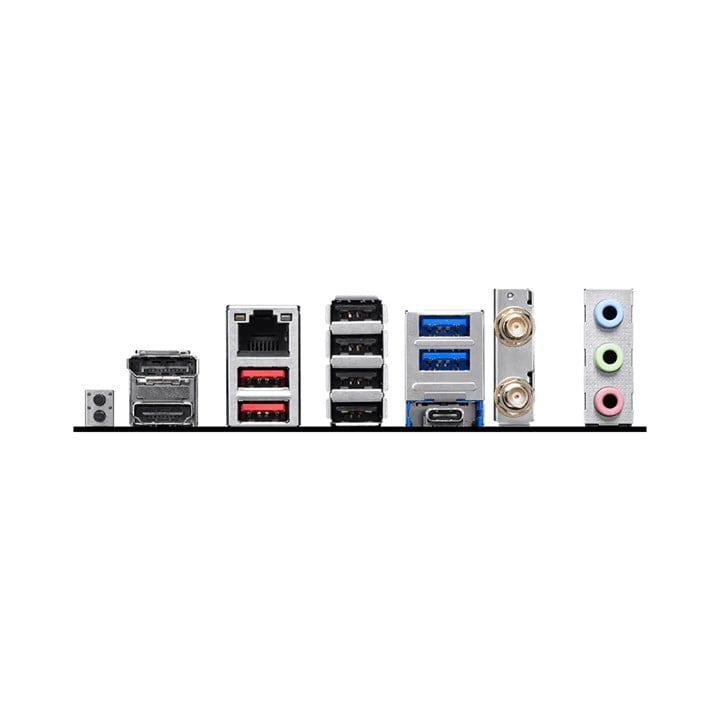
Rear panel I/O ports
USB 2.0 ports quantity
Number of USB 2.0 ports (connecting interfaces) in the device. USB 2.0 was released in April 2000 (now called "Hi-Speed"), adding higher maximum signaling rate of 480 Mbit/s (effective throughput up to 35 MB/s or 280 Mbit/s), USB 2.0 ports are usually black.
4
USB 3.2 Gen 1 (3.1 Gen 1) Type-A ports quantity
The total number of available USB 3.2 Gen 1 (formerly 3.1 Gen 1) Type-A connection ports on the device.
2
USB 3.2 Gen 2 (3.1 Gen 2) Type-C ports quantity
Number of USB 3.1 (3.1 Gen 2) ports with Type-C connector. USB 3.1 (3.1 Gen 2) is USB interface version which supports transfer rate up to 10 Gbit/s (SuperSpeed+). USB Type-C connector has symmetrical design architecture and compatible with Thunderbolt 3 interface.
1
Ethernet LAN (RJ-45) ports
Number of Ethernet LAN (RJ-45) ports (connecting interfaces) in the device. Ethernet LAN (RJ-45) ports allow a computer to connect to the ethernet.
1
HDMI ports quantity
The number of sockets (ports) for HDMI connections. HDMI (High-Definition Multimedia Interface) is a compact audio/video interface for transferring uncompressed video data and compressed/uncompressed digital audio data from a HDMI-compliant device ("the source device") to a compatible computer monitor, video projector, digital television, or digital audio device. HDMI is a digital replacement for existing analog video standards.
1
Rear panel I/O ports
HDMI version
The specific release version of the High-Definition Multimedia Interface standard supported by the device (e.g. 1.3 or 2.0).
2.1
DisplayPorts quantity
Number of DisplayPorts. A DisplayPort is a digital display interface developed by the Video Electronics Standards Association (VESA). The interface is primarily used to connect a video source to a display device such as a computer monitor, though it can also be used to carry audio, USB, and other forms of data.
1
DisplayPort version
The specific release version of the DisplayPort standard supported by the device (e.g., 1.2 or 1.4).
1.4
Network
Ethernet LAN
An Ethernet LAN (Local Area Network) interface is present, for a wired conection via a cable.
 
Ethernet interface type
The maximum data transfer rate supported by the network port, expressed in gigabits per second (e.g., 10 Gigabit Ethernet).
2.5 Gigabit Ethernet
Wi-Fi
Popular technology that allows an electronic device to exchange data or connect to the internet wirelessly using radio waves.
 
Top Wi-Fi standard
Connection of this device is done via Wi-Fi in a high standard.
Wi-Fi 7 (802.11be)
Wi-Fi standards
The type of wireless local area network (LAN). It can be ad-hoc, where units in a network communicate peer-to-peer, or Infrastructure, where units communicate with each other via an access point A LAN interconnects computers in a small area e.g. home, school or office.
Wi-Fi 7 (802.11be)
Bluetooth
Bluetooth is a low-power radio technology developed to replace the cables and wires currently used to link or connect electronic devices such as personal computers, printers, and a wide variety of handheld devices including mobile phones. Because it uses radio-wave connectivity, a Bluetooth-enabled device has a constant, established connection to whatever browser it uses. This saves the user the trouble of logging on to check for emails or news updates, for example.
 
Bluetooth version
The type of bluetooth technology in the product e.g. Bluetooth Smart (v4.0).
5.4
Features
Motherboard chipset
The chipset connects the microprocessor to the rest of the motherboard.
AMD B850
Audio chip
The specific integrated circuit or hardware component responsible for processing audio signals (e.g., ALC3287-CGT).
Realtek ALC897
Audio output channels
An audio output channel is an electric circuit which acts as a path for a signal produced by a device. A device may have several audio output channels.
7.1 channels
Product colour
The colour e.g. red, blue, green, black, white.
Black
Component for
What this product is used as a part of (component for).
PC
Motherboard form factor
Design of the motherboard (ATX, BTX etc).
ATX
Motherboard chipset family
The category of motherboard chipset e.g. Intel, AMD.
AMD
Power source type
What the power source is.
ATX
Expansion slots
PCI Express x1 (Gen 3.x) slots
The number of available PCI Express x1 slots supporting generation 3.x specifications for expanding the device's functionality.
1
PCI Express x4 (Gen 4.x) slots
The number of expansion slots available that support the PCI Express 4.0 standard with x4 lane connectivity.
1
PCI Express x16 (Gen 5.x) slots
The number of available PCI Express x16 slots supporting the 5.0 generation standard for high-speed component connectivity.
1
Number of M.2 (M) slots
The total number of available M.2 M-key slots for installing high-speed storage devices or expansion cards.
3
1st M.2 largest key size
The maximum physical dimensions of the M.2 module supported by the first slot, typically expressed as width and length (e.g., 2280).
2280
1st M.2 highest PCI Express generation
The maximum supported PCI Express version for the first M.2 slot (e.g., 4.0).
5.0
2nd M.2 largest key size
The maximum physical dimensions supported for the second M.2 slot, typically expressed as width and length (e.g. 2280).
22110
2nd M.2 highest PCI Express generation
The maximum supported PCI Express version for the second M.2 slot (e.g., 4.0).
4.0
3rd M.2 largest key size
The maximum physical dimensions supported for the third M.2 slot, typically expressed as width and length (e.g., 2280).
2280
3rd M.2 highest PCI Express generation
The maximum supported PCI Express version for the third M.2 slot (e.g., 4.0).
4.0
BIOS
BIOS type
The BIOS (Basic Input/Output System) initializes and tests system hardware components, and loads a bootloader or an operating system from a mass memory device. The BIOS additionally provides abstraction layer for the hardware, i.e. a consistent way for application p

Fast Next Day Delivery

Over 20 years of Supply, Service & Support

We Source Hard to Find and Legacy Computer Parts

Free Technical Support